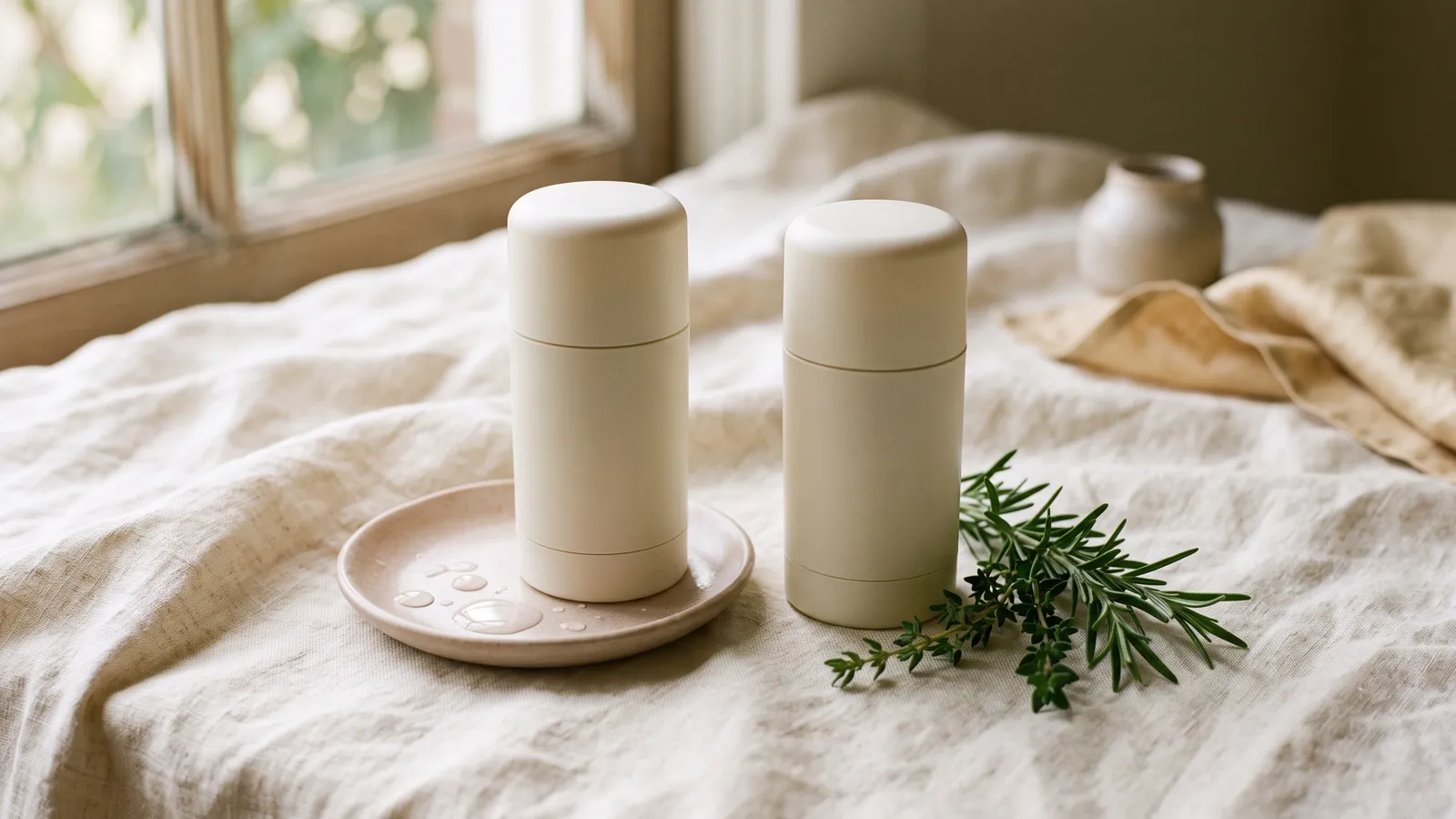
Does aluminum-free deodorant work? It does what deodorant is meant to do, which is control odor. What it can't do is keep you dry, because that's a different product with a different job. Once you know which problem you're solving, choosing gets easy.
Products that help
Details ↓- Check price on Amazon
Affiliate link: we may earn a commission at no extra cost to you.
- Check price on Amazon
Affiliate link: we may earn a commission at no extra cost to you.
- Best fragrance-free aluminum-freeHume Supernatural Whole Body Deodorant Balm (Fragrance Free)Mid-rangeCheck price on Amazon
Affiliate link: we may earn a commission at no extra cost to you.
Deodorant vs antiperspirant: what's the difference?
The American Academy of Dermatology sums it up in six words: "Antiperspirants help reduce sweating. Deodorants don't."
Deodorant works on smell. Dermatologist Dr. Jessie Cheung told TODAY that "body odor is caused by bacteria that feed on sweat." Cleveland Clinic dermatologist Dr. Amy Kassouf describes deodorants as "simply detergents or fragrances that help decrease bacteria and the odor they produce" (Cleveland Clinic). In the US, a deodorant that only works on odor is a cosmetic.
Antiperspirant works on wetness. The National Cancer Institute explains that its aluminum-based compounds "form a temporary 'plug' within the sweat duct that stops the flow of sweat to the skin's surface." That's why the FDA counts "deodorants that are also antiperspirants" as both a cosmetic and a drug.
| Deodorant | Antiperspirant | |
|---|---|---|
| What it targets | Odor | Wetness (and odor if it's also a deodorant) |
| How | Fragrance, acids or other ingredients that work on odor | Aluminum compounds that plug sweat ducts |
| US category | Cosmetic | OTC drug (FDA monograph) |
| Where the label says to use it | Varies; whole body formulas list more areas | "Apply to underarms only" |
What an antiperspirant label is allowed to say
The FDA's antiperspirant monograph sets the wording. The label must call the product an "antiperspirant" and say it reduces (or decreases, or lessens) underarm wetness, sweat or perspiration. It can only say "24 hour protection" or "lasts all day" if testing shows enough sweat reduction over 24 hours, and "extra effective" needs a bigger reduction still.
The same rules require these lines on every antiperspirant:
- "Do not use on broken skin."
- "Stop use if rash or irritation occurs."
- "Ask a doctor before use if you have kidney disease."
- Directions: "apply to underarms only."
So when an aluminum-free product says "72-hour protection," that's about odor, and it's the brand's claim, not an FDA-defined one.
Is aluminum in antiperspirant bad?
Many people switch because of worries about aluminum and breast cancer. The National Cancer Institute's fact sheet says "no scientific evidence links the use of these products to the development of breast cancer." It also notes that studies have been few and their results have conflicted, so more research would be needed to rule a link in or out.
The choice is up to you. Kassouf calls deodorant versus antiperspirant "a matter of personal preference." If you have kidney disease, follow the label and ask your doctor before using an antiperspirant.
How aluminum-free deodorants handle odor
Without aluminum, brands use other ingredients to work on odor:
- Acids (AHAs). Lume uses mandelic acid, which it says "lowers pH to block odor before it starts." Dove's anti-chafe stick uses lactic acid. Dermatologist Dr. Michele Green told NBC Select that AHAs like these "decrease the pH of the underarm."
- Zinc ricinoleate. Hume uses it, and Green points to it as a key ingredient.
- Starches and powders. Happy Curves uses tapioca starch and Dove uses arrowroot powder; Dove says its stick helps "absorb sweat." Absorbing isn't the same as reducing sweat, which is the antiperspirant's job.
- Fragrance. Many deodorants use scent too. If your skin reacts to fragrance, look for an unscented version.
Which aluminum-free deodorant should you choose?
Start with how you like to apply it, then check the ingredients your skin prefers.
| If you want | Look for | Example from our picks |
|---|---|---|
| A cream you can use almost anywhere | An AHA cream with an unscented option | Lume (mandelic acid) |
| A low-cost stick | A drugstore stick with lactic acid | Dove Anti-Chafe Stick |
| No fragrance and no acids | A zinc-based balm | Hume Fragrance Free |
| A stick for under the breasts | A starch-based stick made for that area | Happy Curves |
| Hands-free coverage | A whole body spray | Secret Whole Body Spray |
Two things to keep in mind. First, "72-hour" claims on aluminum-free products are the brand's own odor claims, so read them as a guide, not a promise. Second, a deodorant made for the whole body is the safer choice for skin beyond your underarms. Garshick told NBC Select that "using regular deodorant all over the body can lead to irritation, especially in sensitive areas."
Switching to aluminum-free deodorant: what to expect
1. Expect a change at first
Kassouf says "when you switch your deodorant, your body needs time to adjust to the ingredients," and that the bacteria under your arms can change, so you may notice stronger odor at first. Give a new deodorant a couple of weeks before you judge it. That's our suggestion, not a medical timeline.
2. Skip the armpit detox
Masks and "detox" routines are popular. Kassouf's view: "There are no scientifically proven reasons to do a detox." Washing well is enough.
3. Wash with a gentle cleanser
Kassouf's tip: "Make sure you wash regularly with a gentle, foaming cleanser to remove residual products." Showering after workouts also helps remove sweat and bacteria. Our skin barrier guide explains what makes a cleanser gentle.
4. Apply to clean, dry skin
Dove and Happy Curves both say to start with clean, dry skin and let the product dry before you dress. Reapply during the day if you need to.
5. Patch-test first
Acids and fragrance are new to some skin. Dermatologist Dr. Marisa Garshick told NBC Select to patch-test a new product first, especially on sensitive skin, and to keep deodorant off broken or irritated skin.
6. Keep an antiperspirant if wetness is the problem
If you sweat through shirts, aluminum-free deodorant won't change that. Go back to an antiperspirant on your underarms, and use an aluminum-free whole body deodorant elsewhere. If over-the-counter products aren't enough, Cheung told TODAY "there are prescriptions and other treatments," and a dermatologist can help.
Picks that help
Lume Whole Body Deodorant Cream Tube
Best for: a proven aluminum-free option for underarms and beyond.
- NBC Select named it the best whole body deodorant overall.
- Mandelic acid to lower skin pH; aluminum-free and baking soda-free, with a 72-hour odor claim from the brand.
- Comes unscented if you want to skip fragrance.
Dove Whole Body Deo Anti-Chafe Stick
Best for: a budget-friendly aluminum-free stick that also glides over thighs.
- NBC Select's best whole body stick; Garshick likes its "gentle and nourishing ingredient list."
- Dove says it has a 3.6% AHA serum with lactic acid and is aluminum-free and baking soda-free.
- Dove's FAQ says to avoid private parts with this stick.
Hume Supernatural Whole Body Deodorant Balm (Fragrance Free)
Best for: fragrance-sensitive skin, or acid-free odor control.
- NBC Select's best whole body deodorant balm.
- Uses zinc ricinoleate and oat; aluminum-free and baking soda-free, with a fragrance-free version.
- It's a balm you apply with your fingers, and it contains beeswax.
More options are in our best whole body deodorant roundup, including the Happy Curves Whole Body Deodorant Stick, a starch-based stick made for under the breasts.
FAQs
Does aluminum-free deodorant stop sweat?
No. The AAD is clear: "Antiperspirants help reduce sweating. Deodorants don't." Some formulas use starches, and Dove says its stick helps absorb sweat, but that isn't the same as reducing it.
Why do I smell worse after switching to aluminum-free deodorant?
Your skin is adjusting. Kassouf explains that when you switch, the bacteria under your arms can change, which may cause stronger odor at first. Wash with a gentle cleanser and give it time.
Do I need an armpit detox?
No. Kassouf says "there are no scientifically proven reasons to do a detox," and that "mostly good skin care is all that is needed."
Is aluminum in deodorant linked to breast cancer?
The National Cancer Institute says "no scientific evidence links the use of these products to the development of breast cancer," while noting the research is limited and has conflicted. Choosing aluminum-free is a personal preference, not a requirement.
Can I use antiperspirant and aluminum-free deodorant together?
Yes, in different places. Keep the antiperspirant on your underarms, as the label says, and use a whole body deodorant under your breasts, on your thighs or feet. Our under-boob sweat guide shows how, and our anti-chafing picks cover friction.
Can I use aluminum-free deodorant all over my body?
Only if it's made for that. Whole body deodorants are designed for thinner skin like the under-bust and inner thighs, and some (Lume, Secret, Hume) list the outside of intimate areas. Dove's anti-chafe stick says to avoid private parts. Regular underarm deodorant may irritate other areas, Garshick says.
Is "natural deodorant" the same as aluminum-free?
Not always, so read the ingredient list. Aluminum-free means no aluminum compounds. If your skin is sensitive, also check for fragrance and baking soda: Lume, Dove and Hume leave baking soda out, and Lume and Hume come unscented.
Aluminum-free deodorant does its job well: it handles odor. For wetness, that's what antiperspirant is for.