If your hair comes out crunchy, smells a bit scorched, or still looks frizzy after three passes, the plate material is only part of the story. Most of the time it's the wrong plate for your hair and the wrong temperature.
Products that help
Details ↓- Check price on Amazon
Affiliate link: we may earn a commission at no extra cost to you.
- Check price on Amazon
Affiliate link: we may earn a commission at no extra cost to you.
- Check price on Amazon
Affiliate link: we may earn a commission at no extra cost to you.
- Check price on Amazon
Affiliate link: we may earn a commission at no extra cost to you.
Hair flat iron ceramic vs titanium: what's actually different
Both plates do the same job. They press hair flat with heat. The difference is how they heat and how hard.
| Ceramic | Tourmaline-ceramic | Titanium | |
|---|---|---|---|
| Heat-up | A bit slower | Similar to ceramic | Fastest |
| How heat spreads | Even, gentle | Even | Fast and intense |
| Suits | Fine, damaged, color-treated | Most hair, especially frizz-prone | Thick, coarse, curly, coily |
| Durability | Coating can chip | Coating can chip | Hard-wearing, light |
| Typical budget | Drugstore to splurge | Drugstore to mid-range | Mid-range to splurge |
That table pulls together Ulta's beauty advisors and the stylists NBC Select interviewed. Here's the longer version.
Ceramic: gentle and even
Ulta says ceramic plates "distribute heat evenly across the surface," and "that even heat cuts down on hot spots, which matters if you've got fine, damaged or color-treated hair." Stylist Stefan Bertin told NBC Select ceramic irons are "ideal for those with dry, damaged or fine hair," and cosmetologist Courtney Foster said they glide smoothly and leave a glossy sheen.
The trade-off is that most ceramic plates are a coating over metal. Bertin warns the coating can wear and chip, and when the metal underneath shows, it can damage hair. Foster and Bertin both said people with thick, coarse hair should skip ceramic, because it doesn't usually get hot enough to straighten it well.
Titanium: fast and hot
Ulta calls titanium "a lightweight and durable metal," and says titanium plates "heat up quickly and reach higher temps." That's why stylists like it for thick, curly or coily hair, which takes more heat to lie flat. Titanium also resists scratches, so it holds up to daily salon use.
Here's where the experts don't agree. Foster told NBC Select that titanium spreads heat more evenly than ceramic. Ulta says titanium "can create uneven hot spots if you're not paying attention." What everyone agrees on is the intensity. Trichologist Bridgette Hill told NBC Select that "the heat transfer from titanium is intense, quick and, if used frequently or improperly, can create irreversible heat damage and breakage," and that people with fine or damaged hair should avoid it.
Tourmaline ceramic flat iron: the middle option
Tourmaline is a crushed mineral blended into a ceramic coating. Hill says that blend "offers an extra layer of protection and smoothness," and that tourmaline plates "are a step above the ceramic plates when hair type and texture are medium with loose waves and nominal frizz." Bertin said tourmaline's heat spread means you need fewer passes.
You'll see a lot of claims about ions and frizz on tourmaline irons. Those are the brands' words. The practical upside is simple: if a tourmaline iron gets you smooth in one pass instead of three, that's less heat on your hair.
Ceramic or titanium flat iron: how to choose in 5 steps
1. Start with your hair, not the price tag
Fine, thin, bleached, color-treated or already-damaged hair: ceramic or tourmaline-ceramic. Medium hair with some frizz: tourmaline-ceramic. Thick, coarse, curly or coily hair that a ceramic iron can't get straight: titanium. If two people with different hair share one iron, buy titanium with a wide heat range and keep the fine-haired person's setting low.
2. Make sure you can turn it down
This matters more than the plate. The AAD says flat irons "should be used on dry hair on a low or medium heat setting, no more often than every other day." Stylist Shawn Harvey told NBC Select to start around 250°F for fine hair, 250 to 350°F for medium to thick hair, and 350 to 400°F for thick, coarse hair. A titanium iron on a low setting is gentler than a ceramic iron on its highest one. Look for a digital display or a clearly marked dial.
3. Pick the plate width for your length
Bertin's rule: "Smaller plates are better for short hair, whereas larger plates are better for longer hair." In practice, 1 inch suits most people, 1/2 inch is for bangs and short cuts, and 1.5 inches or more is for long, thick hair. Our best flat iron for fine hair roundup goes into widths in more detail.
4. Check the plates you already own
If your iron snags or pulls, look at the plates under a bright light. Chips, scratches or a dull patch on a ceramic plate mean it's time to replace it. Snagging can also come from plates that don't sit flush, which is what floating plates (plates that flex slightly) are meant to fix.
5. Prep the same way for either plate
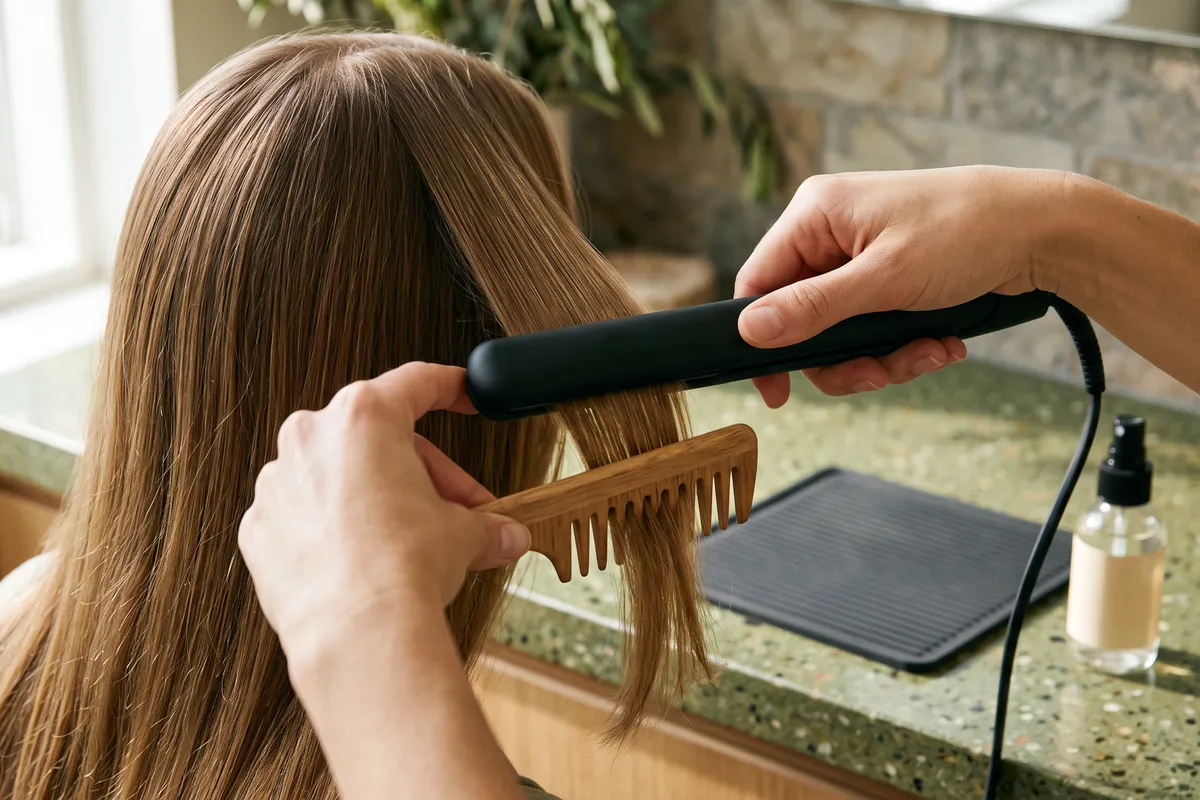
Dry hair only. Then a heat protectant on every section, and let it dry. Then thin sections and one slow pass. Our heat protectant guide covers the details. If you're still getting frizz after that, try a slightly higher setting or smaller sections before you blame the iron.
Titanium hair iron vs ceramic: which problem are you fixing?
- "My hair feels fried or crunchy." Turn the heat down first. If you're on titanium and your hair is fine, switch to ceramic.
- "It takes forever and my thick hair still isn't straight." Ceramic may not be hot enough for you. Titanium is built for this.
- "It snags and pulls." Check for chipped plates. Floating plates and a slower, even pace help too.
- "I'm still frizzy afterward." Use smaller sections and a heat protectant with some smoothing in it, and try tourmaline-ceramic. Our frizzy hair guide covers the rest of the routine.
Picks that help
BaBylissPRO Porcelain Ceramic 1" Styling Iron
Best for: fine or color-treated hair that needs a gentle, even ceramic plate.
- BaBylissPRO says its porcelain ceramic plates "deliver even heat without hot spots," including on fine and color-treated hair, with adjustable heat up to 450°F.
- It weighs 0.46 lb, per the listing, so it's easy to angle.
- Keep in mind: the listing doesn't say what the lowest setting is. Start at the bottom.
Hot Tools Pro Artist Titanium Digital 1" Flat Iron
Best for: thick, coarse or curly hair that ceramic can't get straight.
- Hot Tools describes "one pass fast styling, durability and less frizz" from its titanium plates.
- Floating plates and "variable settings that reach up to 450℉," with a digital display so you can see the heat you're using.
- Keep in mind: on fine hair, keep it low or pick a ceramic iron instead.
INFINITIPRO by Conair Tourmaline Ceramic 1" Flat Iron
Best for: medium or frizz-prone hair on a drugstore budget.
- Conair says the tourmaline-ceramic plates "reduce frizz and boost shine."
- Extra-long floating plates and a 15-second heat-up, per the listing.
- Keep in mind: the listing says both 5 and 30 heat settings. Whatever the count, start low.
TRESemmé Keratin Smooth Heat Protection Spray
Best for: a drugstore heat protectant you can mist before any flat iron.
- TRESemmé says it "helps shield hair from heat up to 450°F," with keratin and marula oil for smoothing.
- The listing calls it a "flat iron spray" made for flat and curling irons.
- Keep in mind: it helps; it doesn't make high heat safe. Turn the iron down too.
FAQs
Is ceramic or titanium better for your hair?
Ceramic is gentler, so it's better for fine, damaged or color-treated hair. Titanium is better for thick or coarse hair that needs more heat. Ulta sums it up: "if your hair is treated or frizz-prone, ceramic is the safer bet."
Ceramic or titanium straightener for curly hair?
For tight curls and coils, most stylists lean titanium because it gets hot quickly and straightens in fewer passes. Ulta adds that if your curls are on the finer side, ceramic "might be the safer choice." Prep with a cream or spray protectant either way.
Is a tourmaline flat iron better than ceramic?
For many people, a little. Tourmaline is mixed into a ceramic coating, and experts NBC Select spoke to say it gives a smoother glide and needs fewer passes. On very fine hair, plain ceramic on a low setting is just as good.
Do titanium flat irons damage hair?
Any flat iron can if it's too hot or used too often. Titanium raises the stakes because it gets hotter, faster. Ulta's advisors put it as "titanium's higher heat ceiling raises the stakes." Used at a low setting with a heat protectant, it's fine on many hair types.
Which lasts longer, ceramic or titanium?
Titanium. NBC Select's experts say titanium straighteners are less likely to wear and chip with frequent use, while ceramic coatings can chip over time. If a ceramic plate is chipped, replace the iron.
What's the best flat iron for fine hair?
A ceramic or tourmaline-ceramic iron with a low heat setting. See our best flat iron for fine hair picks, from drugstore to splurge.
Choose the plate for your hair, then turn the dial down. That second part does more than the first.